Published
Sep 4, 2026
Author
Anna Hauser
The Random Word Method: a ten-minute creative reset that actually works
The Random Word Method: a ten-minute creative reset that actually works
When you're too close to your own brand, the greatest ideas come from the most unexpected directions. Here's a simple technique we use at Playlab Studio and also like to every founder we work with.
When you know your product or service inside out, have been in it for months, maybe years - after a while you may end up defaulting to the same angles. The same language, The same campaign logic. The thinking loops back on itself.
The Random Word Method is a way to break that loop. We use it in strategy sessions, campaign development, and any time a brief starts to feel stuck. It takes ten minutes. It costs nothing. And it works precisely because it is a little absurd.
How it works
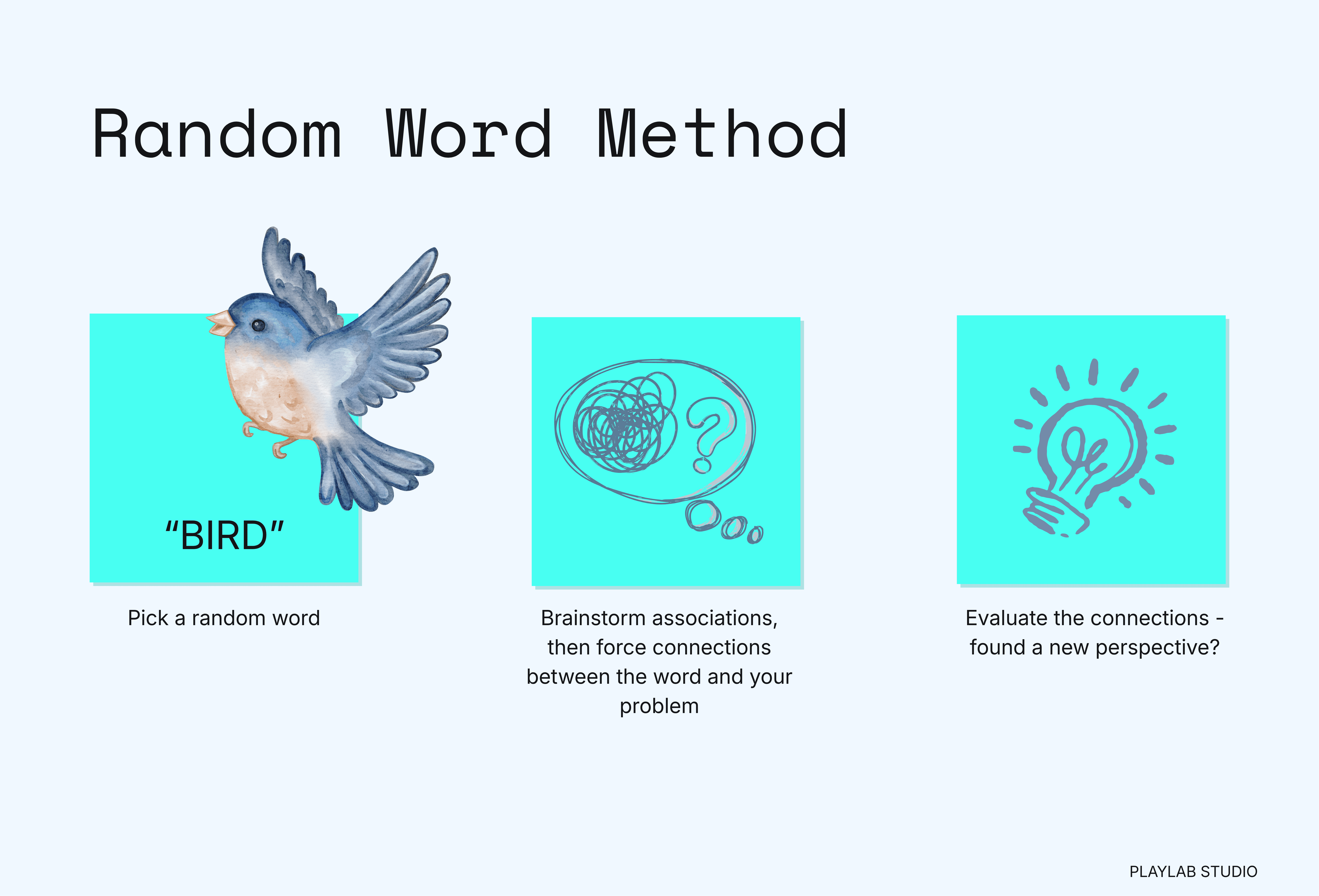
01 Get a random word
Open a book to any page and pick the first noun you see. Use a random word generator. The source doesn't matter, what matters is that the word has nothing to do with your problem. "Lamppost." "Cloud." "Anchor." Any word will do.
02 Free-associate without filtering
Write down every word, image, feeling, or concept that comes to mind when you think about that random word. Don't edit. Don't cross anything out. Then start forcing connections between those associations and your actual problem. Write down anything, even the things that feel ridiculous.
03 Mine the nonsense for signal
Most of what you wrote won't be useful. That's fine. But somewhere in the pile, there will usually be one connection you wouldn't have reached through linear thinking. An angle, a metaphor, a campaign direction that is genuinely fresh.
Why randomness makes you better at strategy
When you think about a problem directly, your brain activates the neural pathways it has already built around that subject. Those are the familiar routes, the experienced patterns. You get fast answers, but rarely surprising ones.
Introducing an unrelated stimulus forces the brain to build new connections. Some of those connections are dead ends. But the act of reaching for them opens up territory you wouldn't have explored otherwise.
In marketing terms: the brands that break through are almost always the ones that found a frame nobody else was using. The Random Word Method is a structured way to go looking for that frame.
The exercise works whether you do it alone, with a co-founder, or inside a workshop. And critically for early-stage brands, it costs nothing except the willingness to feel a little ridiculous for ten minutes.
At Playlab, we think good strategy is mostly about asking better questions. The Random Word Method is one of our favourite tools for generating the questions that matter – the ones that come from somewhere unexpected, and lead somewhere genuinely interesting.
Try it on your next brief. Pick something you see right now. Write for ten minutes. See what surfaces.
WORK WITH US
At Playlab Studio, we bring this kind of strategic creativity to every founder brand we partner with. If you're building something and feel like the marketing has gone a bit flat, let's talk.
When you're too close to your own brand, the greatest ideas come from the most unexpected directions. Here's a simple technique we use at Playlab Studio and also like to every founder we work with.
When you know your product or service inside out, have been in it for months, maybe years - after a while you may end up defaulting to the same angles. The same language, The same campaign logic. The thinking loops back on itself.
The Random Word Method is a way to break that loop. We use it in strategy sessions, campaign development, and any time a brief starts to feel stuck. It takes ten minutes. It costs nothing. And it works precisely because it is a little absurd.
How it works
01 Get a random word
Open a book to any page and pick the first noun you see. Use a random word generator. The source doesn't matter, what matters is that the word has nothing to do with your problem. "Lamppost." "Cloud." "Anchor." Any word will do.
02 Free-associate without filtering
Write down every word, image, feeling, or concept that comes to mind when you think about that random word. Don't edit. Don't cross anything out. Then start forcing connections between those associations and your actual problem. Write down anything, even the things that feel ridiculous.
03 Mine the nonsense for signal
Most of what you wrote won't be useful. That's fine. But somewhere in the pile, there will usually be one connection you wouldn't have reached through linear thinking. An angle, a metaphor, a campaign direction that is genuinely fresh.
Why randomness makes you better at strategy
When you think about a problem directly, your brain activates the neural pathways it has already built around that subject. Those are the familiar routes, the experienced patterns. You get fast answers, but rarely surprising ones.
Introducing an unrelated stimulus forces the brain to build new connections. Some of those connections are dead ends. But the act of reaching for them opens up territory you wouldn't have explored otherwise.
In marketing terms: the brands that break through are almost always the ones that found a frame nobody else was using. The Random Word Method is a structured way to go looking for that frame.
The exercise works whether you do it alone, with a co-founder, or inside a workshop. And critically for early-stage brands, it costs nothing except the willingness to feel a little ridiculous for ten minutes.
At Playlab, we think good strategy is mostly about asking better questions. The Random Word Method is one of our favourite tools for generating the questions that matter – the ones that come from somewhere unexpected, and lead somewhere genuinely interesting.
Try it on your next brief. Pick something you see right now. Write for ten minutes. See what surfaces.
WORK WITH US
At Playlab Studio, we bring this kind of strategic creativity to every founder brand we partner with. If you're building something and feel like the marketing has gone a bit flat, let's talk.
Next Blog
Next Blog